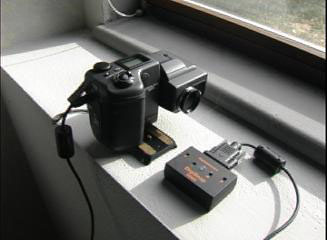
The Nikon Coolpix 995 and Animation Photography
by Jim Arthurs
INTRODUCTION
Second to last in the line of Nikons successful swing lens prosumer cameras, a full feature review can be examined here;
http://www.dpreview.com/reviews/specs/Nikon/nikon_cp995.asp
The 9xx series has a useful and large range of accessories, including fisheye and wide angle lenses, ultra telephoto monocular scopes, and a large cult following with many on-line resources and sites (see links). It is a favorite of the visual effects crowd, and is often used on film sets for recording environmental textures and panoramas for digital effects work.
Over the last couple of years, many short time-lapse animations taken by the 900's have shown up on the web, but no detailed tests have been made on the degree of stability of the exposure of images between frames, or the best group of camera settings to provide the most consistent work.
THE TESTING ENVIRONMENT
The bane of the testing environment is illumination flicker, caused by voltage changes in the line current. While virtually imperceptible to the eye, even a half volt change will be very apparent when viewing a sequence of images recorded over a period of time. Some method of controlling the voltage to the lights is important, and crucial both in testing and actual work. Using a UPS system is one method, but the average computer UPS doesn't keep the line level steady to the degree we're looking for.
If it is impossible to completely eliminate the illumination flicker, it is important to at least identify it and be able to visually subtract its effects from any other potential flicker.
Using an analog voltmeter, visible in frame, is one method (as described and suggested by Antony Bunyan ). By noticing the relationship to the flicker of the image and the subtle dips in the voltmeter it is possible to determine what is camera related flicker and what is illumination flicker.
Another method is the "dual camera" test. A tried and tested animation rig (In my case a video camera feeding a DPS (Lietch) Reality capture card) is used to photograph the same test subject along side the digital still camera. By split screening the images and comparing the flicker, lighting flux can be easily identified.
THE GEAR
For the tests I'm using a Nikon Coolpix 995 on a steady tripod, with a Harbortronics Digisnap 2000 remote trigger/intervalometer. The 3200 K quartz light is running on a PowerCom "line-interactive" computer UPS. A standard voltmeter is visible in frame whenever possible, unfortunately this is a digital volt meter.
METHODS AND SOFTWARE
In all cases the Harbortronics Digisnap was used to take pictures at set intervals.

Frames are recorded at SXGA resolution (1280 by 960), saved as JPEG
images, normal quality to the onboard Compact Flash card. Frames
are rescaled and manipulated in Adobe After Effects. All movie tests
are rendered out in Sorenson codec for Quicktime.
PREVIOUS TESTS
It's important to know that I've done time-lapse work with the 995 before. In those tests I noticed that anything shot at the widest iris setting was virtually flicker free, and sequences taken at the largest f-stop number (smallest iris opening) contained substantially more flicker. What could be causing this?
My first theory was that since the "manual" settings aren't truly manual, but servo controlled approximations, every time the camera took an exposure at a small iris setting it would pop back to full open to allow the maximum amount of light in for the LCD preview. If actually shooting with the camera's iris wide open, it wouldn't have to adjust at all.
In truth, the situation is exactly reversed. In most consumer digi-cams the iris is also used as the mechanical shutter, meaning that it closes completely after preview mode, then pops open to the desired f-stop for the exposure duration, then closes again. After this it opens back to whatever f-stop is needed for the LCD live preview. The problem is that the iris opening is never exactly the correct size again after it's been moved. This small discrepancy produces image flux because the variation is a significant portion of the diameter of the opening when the iris is small, but this same flux is less significant when the iris opening is big.
CAMERA SETTINGS
-focus
Manual
-Exposure Mode Manual
-White Balance 3200K
-LCD monitor Off
-ASA
100
TEST ONE - iris wide open (f2.6)
In this test I've split screened the 995 image sequence with the same scene recorded by a Panasonic DVX-100 feeding a capture card. At the bottom of the screen I've increased the gamma of the image to bring out any flickers. Notice that the flickers are in sync (within a frame or two) of each other. This points out illumination flicker. The still camera doesn't display any additional flicker.
TEST TWO - iris wide open (f2.6)
Here I've used a standard computer UPS system to attempt to hold voltage and reduce line flicker... no luck. I've placed a voltmeter in frame and it clearly shows the flux of voltage over the half hour or so of exposures. If you are able to loop the file you will see a very noticable jump when it changes from beginning to end. This jump occurs with 1.2 volts of difference.
I did a few tests with the iris closed down to the maximum of f7.5. All attempts at the higher f-stop setting were failures. Far too much flicker.
Here is a 2.7 meg Quicktime of the camera recording a cloud time-lapse. This is flicker free, shot with the iris wide open and using the fastest shutter speed in combination with a great deal of ND filtration.
And finally, the same cloud timelapse at a whopping 1280 by 720 HD resolution. These frames were scaled down from full 1920 by 1080 frames. This is a 6 meg file and only works under Windows Media 9 and playback is smooth under a Pentium 2.4 or better. This really demostrates the amazing promise of using high resolution still cameras for this kind of work.
CONCLUSIONS
Doing stop motion or time-lapse work with the 995 is facilitated by the Harbortronics remote release. You can achieve a frame every five seconds and be confident that your images will be flicker free as long as you are in manual mode and the iris is wide open.
The 995 is a discontinued camera, but readily available on e-bay for
around $225 US. Since use is limited to the iris wide open, certain
three dimentional scenes will be difficult to shoot because of limited
depth of field.